Mostrando entradas con la etiqueta Debt-Crisis. Mostrar todas las entradas

5.4.10

Defining Debt Thresholds

Reinhart & Rogoff (2010), Growth in a Time of Debt, found:

First, the relationship between government debt and real GDP growth is weak for debt/GDP ratios below a threshold of 90 percent of GDP. Above 90 percent, median growth rates fall by one percent, and average growth falls considerably more. We find that the threshold for public debt is similar in advanced and emerging economies.

Second, emerging markets face lower thresholds for external debt (public and private)—which is usually denominated in a foreign currency. When external debt reaches 60 percent of GDP, annual growth declines by about two percent; for higher levels, growth rates are roughly cut in half.

Third, there is no apparent contemporaneous link between inflation and public debt levels for the advanced countries as a group (some countries, such as the United States, have experienced higher inflation when debt/GDP is high.) The story is entirely different for emerging markets, where inflation rises sharply as debt increases.

16.3.10

States of Risk

According to Nouriel Roubini:

The Great Recession of 2008-2009 was triggered by excessive debt accumulation and leverage on the part of households, financial institutions, and even the corporate sector in many advanced economies. While there is much talk about de-leveraging as the crisis wanes, the reality is that private-sector debt ratios have stabilized at very high levels.

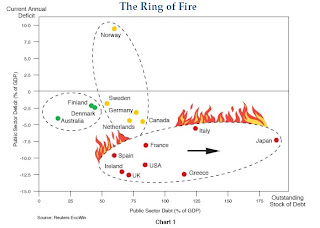
By contrast, as a consequence of fiscal stimulus and socialization of part of the private sector's losses, there is now a massive re-leveraging of the public sector. Deficits in excess of 10% of GDP can be found in many advanced economies, and debt-to-GDP ratios are expected to rise sharply – in some cases doubling in the next few years.

As Carmen Reinhart and Ken Rogoff's new book This Time is Different demonstrates, such balance-sheet crises have historically led to economic recoveries that are slow, anemic, and below-trend for many years. Sovereign-debt problems are another strong possibility, given the massive re-leveraging of the public sector.

24.2.10

Greece

Writing for PS Soros suggested:

"The most effective solution would be to issue jointly and separately guaranteed eurobonds to refinance, say, 75% of the maturing debt, as long as Greece meets its agreed-upon targets, leaving Greece to finance the rest of its needs as best it can. This would significantly reduce the cost of financing, and it would be the equivalent of the IMF disbursing its loans in tranches as long as conditions are met."

"But this is politically impossible at present, because Germany is adamantly opposed to serving as the deep pocket for its profligate partners. Therefore, makeshift arrangements will have to be found."

Forward

"It is clear what is needed: more intrusive monitoring and institutional arrangements for conditional assistance. Moreover, a well-organized eurobond market would be desirable. The question is whether the political will to take these steps can be generated."

15.2.10

¡It was't ready!

In this post I quoted Krugman, Eichengreen and Roubini in order to have a Euro-zone’s Big Picture.

Krugman said that the troubles came from the adoption of the euro before Spain and Greece were ready:

Now what? A breakup of the euro is very nearly unthinkable... As Berkeley's Barry Eichengreen puts it, an attempt to reintroduce a national currency would trigger "the mother of all financial crises". So the only way out is forward: to make the euro work, Europe needs to move much further toward political union, so that European nations start to function more like American states.

But that's not going to happen anytime soon. What we’ll probably see over the next few years is a painful process of muddling through: bailouts accompanied by demands for savage austerity, all against a background of very high unemployment, perpetuated by the grinding deflation I already mentioned.

It’s an ugly picture. But it’s important to understand the nature of Europe's fatal flaw. Yes, some governments were irresponsible; but the fundamental problem was hubris, the arrogant belief that Europe could make a single currency work despite strong reasons to believe that it wasn’t ready.

Eichengreen emphasized the failure to create a "proper emergency financing mechanism"

[…] reating the euro was not a mistake, but it could still be a mistake in the making. The Greek crisis shows that Europe is still only halfway toward creating a viable monetary union. If it stays put, the next crisis will make this one look like a walk in the park.

Completing its monetary union requires Europe to create a proper emergency financing mechanism. Currently, other member states can provide assistance to Greece only by bending the rules, which prevent them from lending except in response to natural disasters or circumstances beyond a country's control. This heightens uncertainty. When Europe’s leaders do help, it makes the public and markets think that they are being dishonest. If it is the Lisbon Treaty that creates these problems, then the Lisbon Treaty should be changed.

Roubini requested a "partial bailout by the EU and the ECB […] in order to avoid the risk of contagion to the rest of the euro zone"

A shadow or actual International Monetary Fund program would vastly enhance the credibility of a policy of fiscal retrenchment and structural reforms. Under the former, the European Commission would impose fiscal and structural conditionality on Greece, while the EU and/or ECB would provide financing, which would be absolutely necessary, because announcing even the best conceived reform program would not be sufficient to restore lost policy credibility. Markets will remain skeptical, especially if implementation leads to street demonstrations, riots, strikes, and parliamentary foot-dragging. Until credibility is re-established, the risk of a speculative attack on public debt – reflected in the current rise in credit default swap spreads – would linger, given the ongoing budget deficit and the need to roll over maturing debt.

Since the European Union has no history of imposing conditionality, and ECB financing could be perceived as a form of bailout, a formal IMF program would be the better approach. The most successful programs undertaken in the presence of a risk of a fiscal and/or external debt financing crisis were those – as in Mexico, Turkey, and Brazil – where a large amount of liquidity/financing support by the IMF beefed up an increasingly credible commitment to adjustment and reform.

Sovereign spreads are already pricing the risk of a domino effect from Greece to Spain, Portugal, and other euro-zone members. The EU and the ECB are worried about the moral hazard of any "bailout". But that is precisely why a credible IMF program that ties financial support to the progressive achievement of fiscal and structural reform goals is the right way to teach Greece and the other PIIGS how to fly.

11.2.10

Three Conclusions and the Past 12-months


Accordingly with Bill Gross based on Reinhart & Rogoff This Time is Different:

"[…] Banking crises are followed by deleveraging of the private sector accompanied by a substitution and escalation of government debt, which in turn slows economic growth and lowers returns on investment and financial assets". [See the Chart]

"What then is an investor to do? If, instead of econometric models founded on the past 30–40 years, an analysis must depend on centuries-old examples of deleveraging economies in the aftermath of a financial crisis, how does one select and then time an investment theme that can be expected to generate outperformance, or what professionals label “alpha?” Carefully and cautiously with regard to timing, I suppose, but rather aggressively in the selection process under the assumption that it’s never “different this time” and that history repeats as well as rhymes. Reinhart and Rogoff’s book, if anything, points to the inescapable conclusion that human nature is the one defining constant in history and that the cycles of greed, fear and their economic consequences paint an indelible landscape for investors to observe. If so, then investors should focus on the following 30,000-foot observations in the selection of global assets."


3.2.10

Greece as Argentina revisited

De acuerdo con Kenneth Rogoff:

"Avoiding default may be possible, but it will not be easy. One has only to look at official data, including Greece’s external debt, which amounts to 170% of national income, or its gaping government budget deficit (almost 13% of GDP)."

"But the problem is not only the numbers; it is one of credibility. Thanks to decades of low investment in statistical capacity, no one trusts the Greek government’s figures. Nor does Greece’s default history inspire confidence (Greece has been in default roughly one out of every two years since it first gained independence in the nineteenth century)."

"[…] Like Argentina, Greece has a fixed exchange rate, a long history of fiscal deficits, and an even longer history of sovereign defaults. Nevertheless, Greece can avoid an Argentine-style meltdown, but it needs to engage in far more determined adjustment."